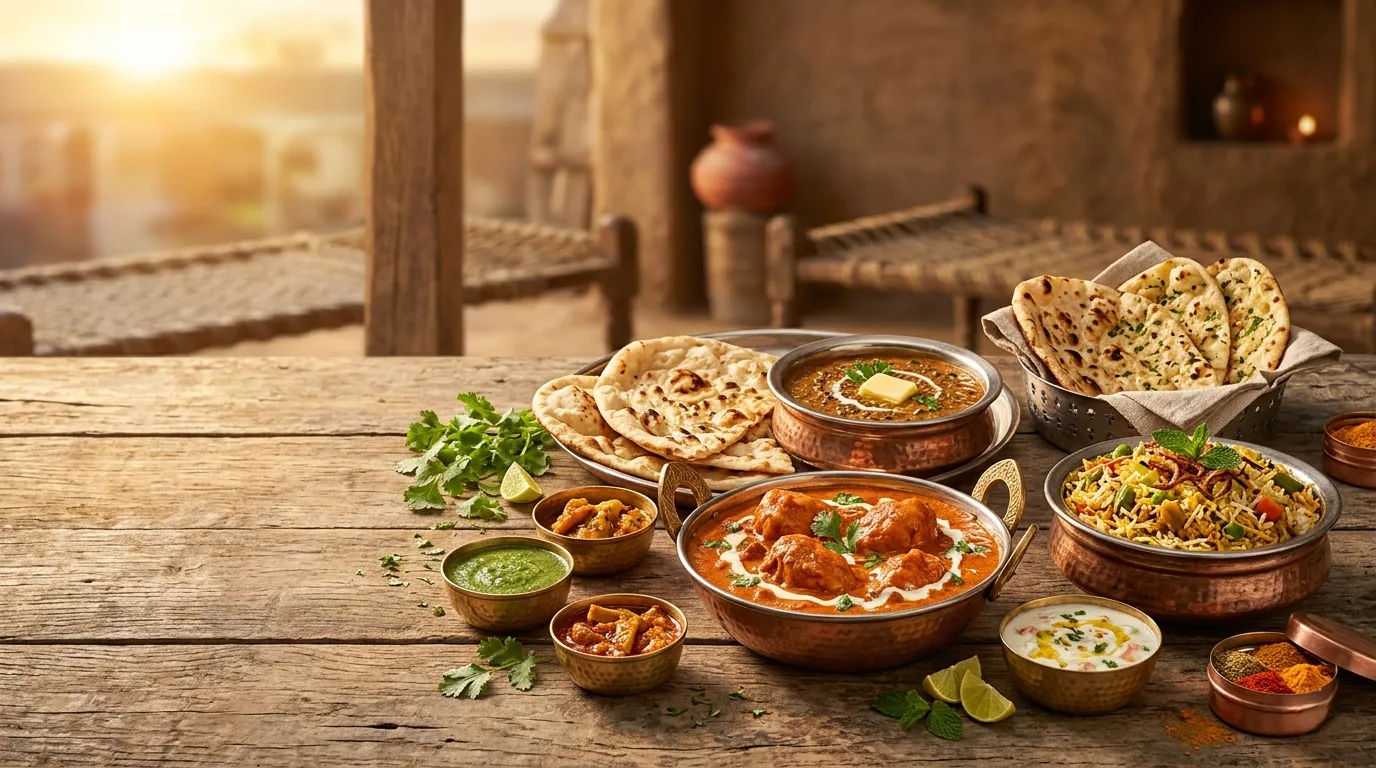
Sarson da Saag is one of Punjab Dhaba's signature curries on the menu at 7619 Argyll Road NW. Mustard greens slow-cooked until creamy and rich, listed at $10.98. More importantly, it sits on the menu year-round. That year-round availability is rare in this city. Most restaurants treat this Punjabi classic as a seasonal winter item.
What is Sarson da Saag — Punjab's original winter comfort food
Sarson da Saag is a creamy mustard greens curry that has been a cornerstone of Punjabi home cooking for generations. Fresh mustard leaves are the foundation. They're harvested in winter across Punjab, then slow-cooked for hours with aromatic spices, ghee, and sometimes cream until the leaves collapse into a silky, dark green curry. The texture is nothing like raw greens or quickly sautéed spinach. Done right, the mustard breaks down completely, becoming almost porridge-like in consistency but never mushy.
The flavor profile is distinctive. Mustard has a subtle bitterness and earthiness that modern Indian cuisine often shies away from, but Punjabi cooks lean into it. That bitter note plays against sweet caramelized onions and the warmth of ginger, garlic, cumin, and fenugreek. Most Punjabis grow up eating this. Few North Indians outside Punjab do. That's why the dish tastes both familiar and exotic at the same time.
Traditionally, Sarson da Saag is paired with makki di roti, a flatbread made from cornmeal. The combination represents a complete harvest dish from rural Punjab: mustard leaves and corn grown in the same fields, cooked together in spirit. In restaurants around Alberta, it typically gets served with butter naan or roti instead, which works fine but loses that cultural symmetry. At Punjab Dhaba, you can ask for the full pairing if it interests you.
The dish occupies a unique position in Punjabi gastronomy. It's not fancy. It's not served at weddings. People cook it for childhood taste. For the cheap ingredients. For warmth through a Punjab winter. When a restaurant in Edmonton keeps it on the menu year-round, they're cooking from memory and principle, not just profit margins.
How Punjab Dhaba makes its Sarson da Saag
What separates good Sarson da Saag from mediocre versions is time. The greens can't be rushed. Punjab Dhaba's kitchen treats the curry as a slow-build process. The kitchen starts with fresh mustard leaves, washed and chopped coarsely, then begins a low simmer with finely minced ginger and garlic. As the leaves soften and release their liquid, the cook adds the aromatic spices: cumin seeds, fenugreek, perhaps a pinch of amchur (dried mango powder) to bridge that bitter-sweet balance. The curry stays on the heat, stirred occasionally, for as long as an hour or more.
The result is a curry that clings to your spoon, rich from butter or ghee worked in near the end. Some kitchens finish with a dollop of cream or a swirl of yogurt, which softens the assertiveness of the mustard. The version here shows that classic dark green, thick enough to cling to your spoon. It tastes like the original, not a diluted version made safe for Canadian palates.
Portion sizes matter. At $10.98, you're getting a full main course serving, enough to share with naan or to eat alone with rice. The price reflects the simplicity of the ingredients and the kitchen's respect for the dish: no fancy plating, no molecular tricks, just slow-cooked greens seasoned well and served hot.
What to eat with Sarson da Saag: pairing on the menu
If you're ordering Sarson da Saag at Punjab Dhaba, the bread choice matters. Butter naan is the safe play, and it works: the richness of the naan balances the bitter earthiness of the greens. If you want something lighter, steamed rice absorbs the curry cleanly without competing for your attention. For purists, makki di roti (cornmeal bread) is the authentic pairing, and if the kitchen has it available, request it specifically.
Many diners order Sarson da Saag as part of a combination, not solo. A common approach is to pair it with Dal Makhni, the restaurant's rich lentil curry. The contrast between the earthiness of the greens and the buttery sweetness of the dal works beautifully. Or pair it with Matar Paneer, the soft paneer and peas in tomato gravy, for a fully vegetarian spread. If you're eating as a group, the Veg Thali is another option: a curated plate that includes one dal, one vegetable, paneer, raita, a sweet dish, salad, and bread. The thali gives you a breadth of flavors in one order, and the Sarson da Saag could easily anchor it as the curry component.
A pro tip: order the Sarson da Saag if you want to taste what real Punjabi home cooking tastes like. It's not flashy. It's not Instagram-friendly. But the owners describe their food as homemade, and Sarson da Saag is the truest expression of that philosophy on the menu.
Other Punjabi vegetarian mains worth ordering
Punjab Dhaba's vegetarian section goes beyond just Sarson da Saag. If you're vegetarian or simply exploring the menu, the restaurant has built a solid roster of options. Dal Makhni is the signature: slow-cooked black lentils simmered with butter and spices, finished with a swirl of cream. It's rich comfort in a bowl, the kind of dal that made this restaurant's reputation and keeps regulars coming back. At $10.98, the same price as Sarson da Saag, it represents remarkable value for the labor involved.
Matar Paneer is a lighter choice. Soft paneer cubes paired with tender green peas in a spiced tomato gravy. The tomato base keeps it bright and a bit sweet, contrasting with the more austere greens curry. It's familiar to anyone who's eaten Indian food before, but the quality of the paneer and the balance of spices at Punjab Dhaba elevate it above average.
The Veg Thali at $12.98 is designed for someone who wants breadth. You get a dal, a sabji (vegetable dish), paneer, raita, a sweet dish, salad, and your choice of roti or rice. It's a full meal structured like a traditional Punjabi family dinner. The kitchen builds each component thoughtfully, so no item feels like it's there just to fill space on the plate.
Where to find us in Argyll + how to order
Punjab Dhaba sits at 7619 Argyll Road NW in Argyll. Regulars come from nearby Avonmore and Bonnie Doon. The restaurant is open 11:00 AM to 11:00 PM, 7 days a week, every day of the year.
Ordering Sarson da Saag is simple. Call 780-244-4474 to speak with the staff, or visit our contact page for hours and directions. We deliver across south-east neighborhoods including Capilano, Sherbrooke, and Greenview. If you're ordering from Bonnie Doon or Avonmore, or from delivery zones like Hillview or Woodvale, call ahead to confirm coverage. The kitchen serves a wide delivery radius.
Ready to taste authentic Punjabi comfort food?
Order Sarson da Saag with fresh naan or rice and experience the creamy, earthy flavors of Punjab's most iconic winter curry. Available year-round at Punjab Dhaba. Dine in, pick up, or have it delivered to your home in AB.
Order Online NowFrequently Asked Questions
What is Sarson da Saag?
Sarson da Saag is a creamy mustard greens curry that originates from Punjab, a region in northern India. Fresh mustard leaves are slow-cooked for hours with spices until silky and smooth, creating a distinctive dark green curry. The traditional pairing is with makki di roti, a flatbread made from cornmeal. It's considered Punjab's iconic winter comfort food.
Is Sarson da Saag vegetarian?
Yes, Sarson da Saag is a vegetarian dish. It's made entirely from mustard greens, spices, and butter or cream. At Punjab Dhaba, it's served for $10.98 and listed among the main course vegetarian options.
When is the best time to eat Sarson da Saag?
Sarson da Saag is traditionally a winter dish because mustard greens are harvested in the colder months in Punjab. However, at Punjab Dhaba in Argyll, Edmonton, it's available year-round, not just seasonally. You can order it any time.
How is Punjab Dhaba's Sarson da Saag different from other Indian restaurants?
Punjab Dhaba treats Sarson da Saag as a signature year-round menu item, not a seasonal special. The kitchen slow-cooks the mustard greens using traditional Punjabi methods to achieve that authentic creamy texture. Customers consistently praise the restaurant for food that tastes homemade and genuine.